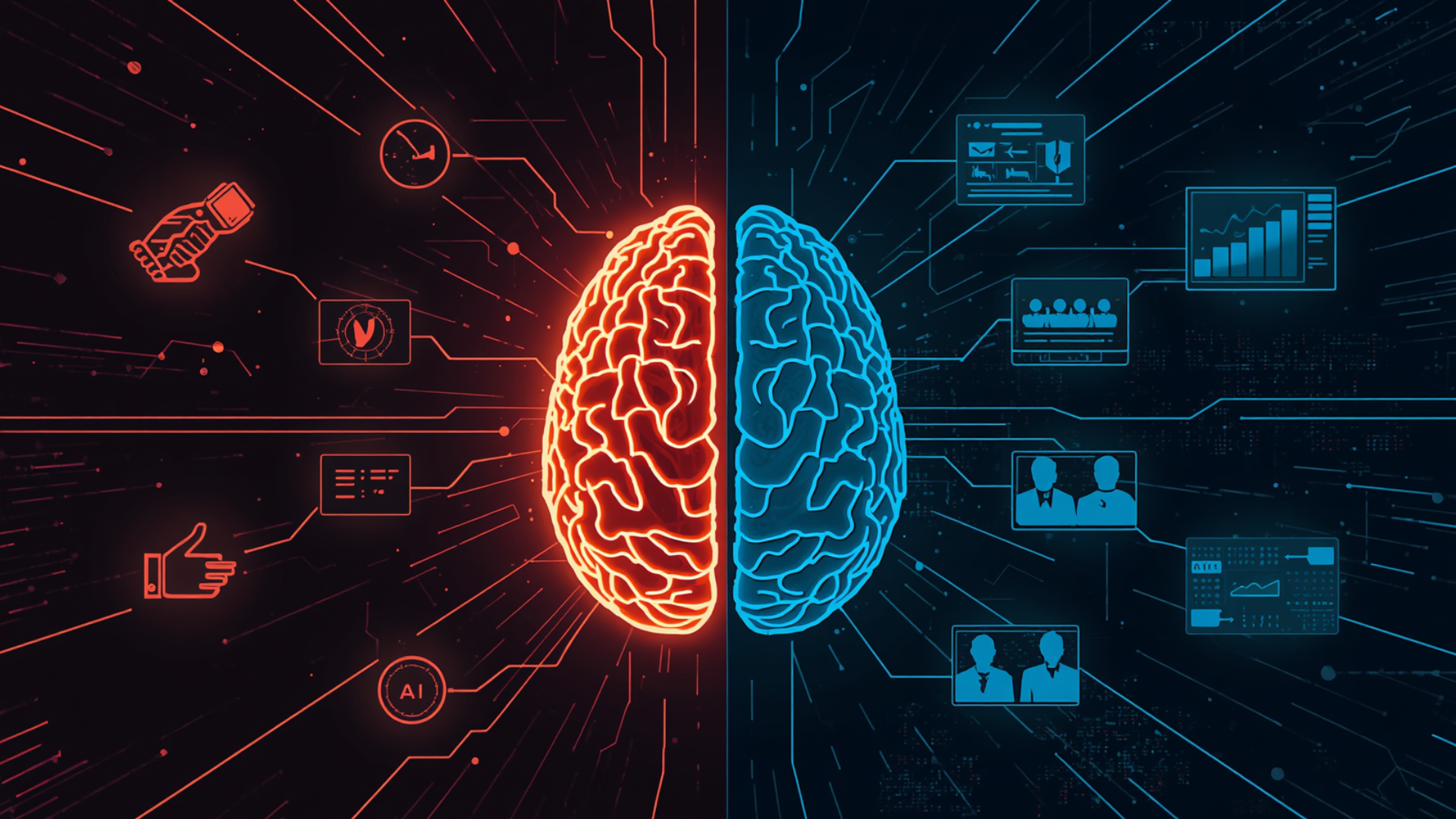
The technology gets all the attention. Deepfakes. Voice cloning. AI-generated phishing emails. We talk about the tools, the sophistication, the frightening realism.
But the technology isn’t the exploit.
In February 2024, a finance worker at the global engineering firm Arup attended what seemed like a routine video conference. The CFO was there. Senior executives were present. The meeting felt normal. By the end of the call, $25.6 million had been transferred to fraudsters.
Every person on that call - aside from the victim - was an AI-generated deepfake.
But here’s what matters: the AI didn’t steal that money. Human psychology did.
The worker trusted what they saw. They trusted the familiar faces. They trusted the authority in the room. They trusted the process. And that’s exactly what the attackers counted on.
The technology was just the delivery mechanism. The real exploit was trust, authority, and the fundamental human instinct to comply when someone who looks like your boss asks you to do something.
This is the uncomfortable truth about social engineering: AI didn’t create the vulnerabilities. It just made exploiting them faster, cheaper, and more scalable.
The psychological mechanisms that make manipulation work - authority, urgency, trust, fear, reciprocity, social proof - existed long before computers. They’re hardwired into human neurology. They evolved over millions of years because they helped us survive.
And attackers have always known how to weaponize them.
What changed with AI is scale and sophistication. A single attacker can now run hundreds of personalized campaigns simultaneously. Voice cloning creates perfect audio impersonations. Deepfakes generate convincing video. Language models produce flawless, culturally-adapted text.
But the psychology underneath? That’s ancient. That’s unchanging. That’s the real vulnerability.
This series isn’t about AI capabilities or attack techniques. It’s about why social engineering works at a fundamental level. It’s about the neuroscience, the evolutionary biology, the cognitive mechanisms that make humans predictable targets.
Because if you want to defend against manipulation - or understand why defenses fail - you need to understand the psychology first.
The technology will keep improving. The human brain won’t.
The Human Psychology Behind Every Successful Attack
Social engineering isn’t a technology problem. It’s a human problem.
Every successful attack exploits fundamental psychological principles that existed long before email or AI. These aren’t bugs in human nature - they’re features. They help us function in society, build relationships, and cooperate at scale.
And attackers know exactly how to weaponize them.
The Six Psychological Triggers
1. Authority
Humans are wired to comply with authority figures. It’s how societies function. When someone with perceived authority makes a request, our default response is obedience, not skepticism.
- A “CFO” requesting a wire transfer gets compliance
- An “IT administrator” asking for credentials gets compliance
- A “senior executive” demanding urgency gets compliance
Why it works - the evolutionary basis:
Authority response isn’t learned behavior. It’s hardwired survival.
In early human societies, defying the tribal leader could mean exile or death. Children who didn’t obey parents didn’t survive to reproduce. Soldiers who questioned commanders in battle got themselves and their units killed. The humans who survived were the ones who defaulted to compliance with authority.
This response is so fundamental that Stanley Milgram’s famous 1961 experiment demonstrated people would administer what they believed were lethal electric shocks to strangers simply because an authority figure in a lab coat told them to. 65% of participants went all the way to the maximum voltage. They weren’t cruel. They were obedient.
What’s happening in your brain:
When you perceive authority, your prefrontal cortex (responsible for critical thinking and decision-making) partially deactivates. Brain imaging studies show that authority figures trigger what neuroscientists call “neural suppression” - your brain literally reduces activity in the regions responsible for questioning and analysis.
At the same time, your anterior cingulate cortex (which processes social hierarchy and error detection) lights up. You become hyper-aware of your position relative to the authority figure. Your brain is optimizing for compliance, not analysis.
Why understanding this matters:
If you’re an attacker, you’re not just pretending to be someone important. You’re triggering a neurological response that suppresses critical thinking. The more convincingly you signal authority (title, tone, confidence), the less capable your target becomes of questioning you.
If you’re a defender, you’re not fighting laziness or carelessness. You’re fighting millions of years of evolution. Training employees to “question authority” is asking them to override hardwired survival instincts. That’s why verification protocols matter - they give people a process that bypasses the need to consciously resist authority.
The Arup worker didn’t question the CFO’s request because authority bypasses skepticism at a neurological level. When your boss asks you to do something, your brain reduces its questioning capacity. That’s not carelessness - that’s biology.
2. Urgency
Time pressure short-circuits critical thinking. When we’re rushed, we rely on mental shortcuts instead of careful analysis.
- “This needs to be done before 5 PM”
- “The audit is tomorrow and we’re missing documents”
- “Your account will be locked in 30 minutes if you don’t verify”
Why it works - the dual-process theory:
Your brain operates on two systems, described by psychologist Daniel Kahneman as System 1 (fast, automatic, emotional) and System 2 (slow, deliberate, logical).
System 1:
- Instant pattern recognition
- Gut reactions
- Emotional responses
- Operates without conscious effort
- Error-prone but fast
System 2:
- Analytical thinking
- Deliberate consideration
- Logical evaluation
- Requires conscious effort
- Accurate but slow
Under normal conditions, System 2 monitors System 1 and catches mistakes. But System 2 is energy-expensive. It requires glucose, attention, and cognitive bandwidth. When you’re tired, stressed, or rushed, System 2 shuts down to conserve resources.
Urgency is a direct attack on System 2.
What’s happening in your brain:
Under time pressure, your amygdala (emotional processing) becomes hyperactive while your dorsolateral prefrontal cortex (analytical reasoning) reduces activity. You literally become more emotional and less rational.
Studies show that people make significantly worse decisions under time pressure - not because they don’t know better, but because the brain regions responsible for “knowing better” are temporarily suppressed.
Why understanding this matters:
If you’re an attacker, urgency isn’t just a narrative device. It’s a neurological attack that forces your target into System 1 thinking. The tighter the deadline, the less capable they become of spotting inconsistencies. “We need this done in 30 minutes” isn’t just pressure - it’s cognitive sabotage.
If you’re a defender, you’re not teaching people to “slow down and think.” You’re teaching them to recognize when their brain is being forced into fast-thinking mode and deliberately activate System 2 anyway. That’s hard. It requires conscious effort against biological pressure.
The defense mechanism: Create artificial delays. “Any urgent request requires a 10-minute verification period.” This forces System 2 back online. Legitimate urgent requests survive a 10-minute delay. Fraudulent ones often can’t.
3. Trust
We want to believe people are who they say they are. It’s cognitively easier to trust than to verify.
- If someone looks like my CFO, sounds like my CFO, and is on a company video call, my brain defaults to “that’s my CFO”
- If an email comes from a familiar-looking domain, we assume it’s legitimate
- If the request seems reasonable, we don’t look for red flags
Why it works - cognitive efficiency and social contracts:
Trust is not naivety. It’s cognitive efficiency.
If you had to verify every single interaction, you’d be paralyzed. Is that really your coworker asking for the file? Better call them. Is that really your boss in the meeting? Better check their ID. Is that really the IT system email? Better verify with IT directly.
Verification is expensive. It costs time, attention, and social capital. Your brain is optimized to conserve these resources, so it defaults to trust when contextual cues align.
This is called the “truth-default theory” in social psychology. Humans operate under the assumption that communication is honest until proven otherwise. We evolved this way because societies cannot function without baseline trust. If everyone assumes everyone else is lying, cooperation collapses.
What’s happening in your brain:
When you encounter familiar cues (someone who looks like your boss, an email from a known domain, a request that seems normal), your brain releases oxytocin - the “bonding hormone.” Oxytocin increases trust and reduces threat detection.
Your ventromedial prefrontal cortex (which evaluates trustworthiness) makes snap judgments based on pattern matching. If the pattern matches “familiar and safe,” skepticism is actively suppressed.
Brain imaging studies show that when we trust someone, our anterior insula (which processes risk and uncertainty) shows reduced activity. We literally perceive less risk when we trust.
Why understanding this matters:
If you’re an attacker, you’re not fooling people. You’re exploiting the brain’s default mode. By mimicking familiar patterns (voice, appearance, communication style), you’re triggering neurochemical responses that suppress threat detection. The better your mimicry, the stronger the oxytocin response, the weaker the skepticism.
If you’re a defender, you’re not fighting gullibility. You’re fighting cognitive efficiency. People trust by default because questioning everything is metabolically and socially expensive. That’s why “verify anyway” protocols work - they don’t require individuals to overcome trust instincts. The protocol does it for them.
Trust is the grease that makes society function. But in security, trust is also the vulnerability. And AI-generated deepfakes don’t just look like your boss - they trigger the exact neurological responses that suppress your ability to question whether they’re real.
4. Fear
Fear triggers action. Threatening something we care about - our job, our security, our reputation - overrides rational thinking.
- “Your account has been compromised”
- “We detected unusual activity”
- “Failure to respond will result in…”
Why it works - the amygdala hijack:
Fear is the brain’s emergency override system.
When you perceive a threat, your amygdala - a small, almond-shaped structure deep in your brain - activates before your conscious mind even registers what’s happening. This is called an “amygdala hijack,” and it’s a survival mechanism that kept our ancestors alive when threats were physical and immediate.
The neurological cascade:
- Threat detected (email says “your account is compromised”)
- Amygdala activates (0.02 seconds - faster than conscious thought)
- Stress hormones released (cortisol and adrenaline flood your system)
- Prefrontal cortex suppressed (analytical thinking reduces)
- Action bias activated (brain prioritizes doing something over thinking about it)
Your body is preparing for fight-or-flight. Your heart rate increases. Your focus narrows. Your decision-making shifts from “what’s the best choice?” to “what stops this threat fastest?”
This response evolved to save you from predators. When a lion charges, you don’t want to analyze options - you want to run. The problem is that your amygdala can’t tell the difference between a lion and a phishing email claiming your account is compromised.
Why understanding this matters:
If you’re an attacker, fear is the most powerful trigger in your arsenal. It bypasses conscious thought entirely. The target isn’t deciding whether to comply - their threat response system is deciding for them. The more immediate the perceived threat (“Your account will be locked in 30 minutes”), the stronger the amygdala hijack.
In January 2025, fraudsters in Hong Kong used AI-generated voice cloning to impersonate a finance manager. They didn’t just ask for money - they created a sense of crisis. The combination of urgency (time pressure) + fear (financial threat) + authority (manager’s voice) created a neurological perfect storm. The victim’s brain was optimizing for threat elimination, not threat verification.
If you’re a defender, you’re not fighting cowardice. You’re fighting a survival mechanism that evolved over millions of years. When someone feels afraid, their analytical brain is literally offline. That’s why “stay calm and verify” training often fails - you’re asking people to consciously override an unconscious survival response.
The defense mechanism: Recognize the physical sensation of fear (racing heart, tunnel vision, urgency to act) as a red flag itself. Create protocols that activate when you feel afraid, not just when you detect something suspicious. “If I feel scared or pressured, I follow the verification protocol before acting.”
5. Reciprocity
When someone does something for us, we feel obligated to return the favor. Social engineers manufacture this obligation.
- “I covered for you last time, can you help me with this?”
- “I’m in a tough spot, I really need your help”
- “We’ve worked together before, I trust you to handle this”
Why it works - the reciprocity norm:
Reciprocity is one of the most powerful social norms in human civilization. Dr. Robert Cialdini, who spent decades studying influence and persuasion, identified it as the first principle of social influence in his landmark work “Influence: The Psychology of Persuasion.”
The mechanism is simple: When someone gives you something (a favor, help, information, even just attention), you feel indebted. That psychological debt creates pressure to reciprocate, even if the initial “gift” was unsolicited.
The reciprocity norm is so strong that it works across cultures, economic systems, and historical periods. Anthropologists have found it in every studied human society. It’s how trust networks form. It’s how communities function.
Why this evolved:
Early human survival depended on cooperation. You share food today, I share food tomorrow. You help me build shelter, I help you hunt. But cooperation only works if debts are honored. Humans who refused to reciprocate were excluded from the group, which was often a death sentence.
We evolved a psychological discomfort around unpaid social debts. That discomfort is so strong that studies show people will reciprocate even when:
- They didn’t ask for the initial favor
- The favor was small or unwanted
- The reciprocation costs more than the original favor
- They know they’re being manipulated
What’s happening in your brain:
When someone does you a favor, your brain’s reward system activates, releasing dopamine. But at the same time, your anterior cingulate cortex (which processes social obligations and error detection) creates psychological tension. That tension doesn’t resolve until you reciprocate.
Brain imaging studies show that unpaid social debts create similar neural patterns to unfinished tasks or unresolved conflicts. Your brain is literally keeping track of who you owe, and it creates discomfort until the debt is cleared.
Why understanding this matters:
If you’re an attacker, you don’t start with a big ask. You start by creating a debt. You help the target with something small. You provide useful information. You do them a favor. Each positive interaction creates psychological debt that can be called in later.
Good social engineers build rapport over time. They create multiple small obligations before making their real request. By the time they ask for credentials or financial information, the target feels like refusing would make them a bad colleague or an ingrate.
If you’re a defender, you’re not fighting selfishness. You’re fighting one of the strongest social bonds humans have. Reciprocity is how relationships work. Refusing to reciprocate feels like a moral violation. That’s why attackers exploit it.
The defense mechanism: Recognize manufactured obligation. Ask yourself: “Did I ask for this favor, or was it unsolicited? Is the reciprocation proportionate, or am I being asked for something far more valuable than what I received?” If the debt feels artificial or disproportionate, it probably is.
6. Social Proof
We look to others to determine correct behavior. If “everyone else” is doing something, it must be okay.
- “All the other departments have already submitted theirs”
- “Everyone else approved this already”
- “This is standard procedure, we do it all the time”
Why it works - informational social influence:
Social proof is a cognitive shortcut based on a logical premise: in uncertain situations, the crowd is probably right.
If you’re walking down a street and everyone suddenly starts running, you don’t stop to analyze why. You run too. Because in our evolutionary past, the people who stopped to think “I wonder why everyone’s running?” got eaten by whatever everyone else was running from.
This is called “informational social influence” in social psychology. We assume other people have information we don’t, so we use their behavior as data.
The Asch conformity experiments (1950s) demonstrated this powerfully. Participants were shown two lines of obviously different lengths and asked which was longer. When surrounded by confederates who confidently gave the wrong answer, 75% of participants conformed and gave the wrong answer too - even though their eyes told them otherwise.
They weren’t stupid. They weren’t weak. They were using a heuristic that usually works: trust the group consensus.
Why this evolved:
For most of human history, going against the group was dangerous. If the tribe says “that plant is poisonous,” and you eat it anyway because you think you know better, you die. If the tribe says “we’re moving to higher ground,” and you stay in the valley, you get flooded. Survival favored those who trusted group consensus over individual judgment.
This created a psychological mechanism where group behavior becomes evidence of correctness, even when it contradicts our own perception.
What’s happening in your brain:
When you observe others making a choice, your brain’s mirror neuron system activates. These neurons fire both when you perform an action and when you observe someone else performing it. This creates a subtle pressure to mimic observed behavior.
Additionally, when your choice conflicts with group consensus, your anterior cingulate cortex (error detection) activates - the same region that fires when you make a mistake. Your brain is literally signaling that disagreeing with the group might be an error, even if you’re right.
Why understanding this matters:
If you’re an attacker, social proof is about creating the illusion of consensus. You don’t need to convince the target that something is safe - you need to convince them that other people already decided it was safe.
“Everyone else has already approved this” isn’t just information. It’s psychological pressure. If five people have already wired money to this account, it feels safe to be the sixth. The target isn’t evaluating the request independently anymore - they’re deferring to the (fabricated) group consensus.
This is why business email compromise attackers often reference other approvals, other transactions, or “standard procedure.” They’re manufacturing social proof.
If you’re a defender, you’re not fighting groupthink. You’re fighting a survival heuristic that works most of the time. In legitimate situations, following group consensus is efficient. The challenge is distinguishing real consensus from fabricated consensus.
The defense mechanism: Verify independently. “Everyone else approved” requires verification that those approvals actually exist and came from legitimate sources. Real social proof survives verification. Fake social proof doesn’t.
If five people wired money to this account, can you confirm that with at least one of them? If this is “standard procedure,” can you find documentation of that procedure? If “everyone else is doing it,” who exactly is “everyone”?
Why Understanding Psychology Matters (Not Just Knowing It)
There’s a critical difference between knowing these triggers exist and understanding why they work at a fundamental level.
Knowing:
- “Social engineers use urgency to pressure people”
- “Authority figures get compliance”
- “Fear makes people act without thinking”
Understanding:
- Why urgency suppresses analytical brain regions
- Why authority triggers neural responses that reduce questioning
- Why fear activates survival systems that bypass conscious thought
This distinction matters for both attackers and defenders.
For Attackers: Exploitation vs. Mimicry
An attacker who knows the triggers can copy existing attack patterns. “I’ll pretend to be the CEO and say it’s urgent.” That’s mimicry.
An attacker who understands the psychology can engineer novel attacks. They know that authority works because of neural suppression, so they can test which signals trigger that response most effectively. They know that urgency works because it forces System 1 thinking, so they can calibrate the exact amount of time pressure that disables System 2 without triggering obvious suspicion.
Example of the difference:
Mimicry (knowing):
“URGENT: CEO request. Wire $50K immediately.”
Problems: Too obvious, triggers alarm bells, doesn’t feel contextually real.
Psychology-engineered (understanding):
“Hi [John], [Doe CEO] is in a client meeting and asked me to reach out. We’re finalizing the acquisition agreement and need to transfer funds to escrow before close of business to meet the deadline in the contract. Can you process the wire to [123556] for $50K? Details attached. He’ll confirm afterward but said you’d know the context from last week’s leadership meeting.”
Why this works better psychologically:
- Authority (CEO) but filtered through appropriate channel (makes sense procedurally)
- Urgency (contract deadline) with specific context (not arbitrary pressure)
- Trust (references prior meeting) creates familiarity
- Social proof (implied that others are involved in the acquisition)
- Plausibility (CEO can’t personally handle wire during client meeting - that’s realistic)
The first attacker copied a template. The second attacker engineered a psychological sequence.
For Defenders: Symptoms vs. Root Causes
A defender who knows the triggers can train employees on red flags. “Watch out for urgent requests from executives asking for wire transfers.”
A defender who understands the psychology can design interventions that address root causes. They know that urgency disables System 2 thinking, so they create mandatory delay protocols that force System 2 back online. They know that authority suppresses questioning, so they create depersonalized verification systems that don’t require individuals to challenge authority figures directly.
Example of the difference:
Red flag training (knowing):
“Be suspicious of emails that say ‘urgent’ or claim to be from executives.”
Problem: This fights symptoms. It also creates alert fatigue because many legitimate emails are urgent and from executives.
Psychology-based defense (understanding):
“All wire transfer requests follow a three-step protocol: (1) 10-minute mandatory wait period, (2) verbal confirmation via known phone number, (3) second-person approval. This applies even for legitimate executive requests.”
Why this works better:
- Addresses System 1/System 2: The 10-minute wait forces analytical thinking back online
- Removes individual responsibility: Employees don’t have to challenge authority - the protocol does it
- Universal application: Applies to all requests, so no judgment calls about “is this suspicious?”
- Verification that survives psychology: Even if the target feels authority/urgency/trust, the protocol catches fraud
The first defender taught symptoms. The second defender designed systems that account for how human brains actually work under psychological pressure.
The Meta-Awareness Advantage
The deepest level of understanding is meta-awareness: recognizing your own psychological state in real-time.
Most people experience urgency, authority, or fear without recognizing that they’re experiencing it. They feel pressure, but they don’t label it as “my amygdala is hijacking my prefrontal cortex.” They feel compelled to comply, but they don’t recognize “my brain just suppressed questioning because of authority signals.”
Meta-awareness training:
Instead of “watch out for urgent requests,” teach “when you feel rushed, that’s your brain entering System 1 mode. Recognize that feeling as a trigger to slow down.”
Instead of “be skeptical of authority,” teach “when you feel uncomfortable questioning someone, that’s neural suppression. Recognize that discomfort as evidence you should verify anyway.”
This is harder to train. It requires people to develop psychological self-observation skills. But it’s also more effective because it works even when the attack doesn’t match known patterns.
If you can recognize “I feel afraid and pressured to act immediately” as a psychological state being induced, you can catch novel attacks that don’t look like previous phishing attempts.
What’s Next
This article covered why social engineering works at a fundamental level - the neurological and evolutionary mechanisms that make these six triggers so powerful.
But understanding the triggers is only part of the story.
In Part 2, we’ll explore one of the most frustrating scenarios in security: when people feel suspicious but comply anyway. Why does cognitive dissonance override intuition? Why do people rationalize away their own warning signals? And what happens psychologically in that moment when someone thinks “something feels off” but acts anyway?
In Part 3, we’ll examine the uncomfortable paradox: knowing about these attacks doesn’t make you immune to them. Security professionals still fall for sophisticated social engineering. Intelligence doesn’t protect you. Expertise can create new blind spots. We’ll explore why knowledge doesn’t equal immunity, and what actually does protect against manipulation.
The psychology is the exploit. The technology just scales it.
And understanding that distinction is the first step toward building defenses that actually work.